
Ratified
fabcheck
Reads text or a markdown file and produces a claimed-vs-verified ledger in the house format.
tools/fabcheck/Continuity & Context · Sandboxed AI Research
In plain terms: we test whether an AI can carry its memory between conversations using files a person owns, instead of memory hidden inside the model.
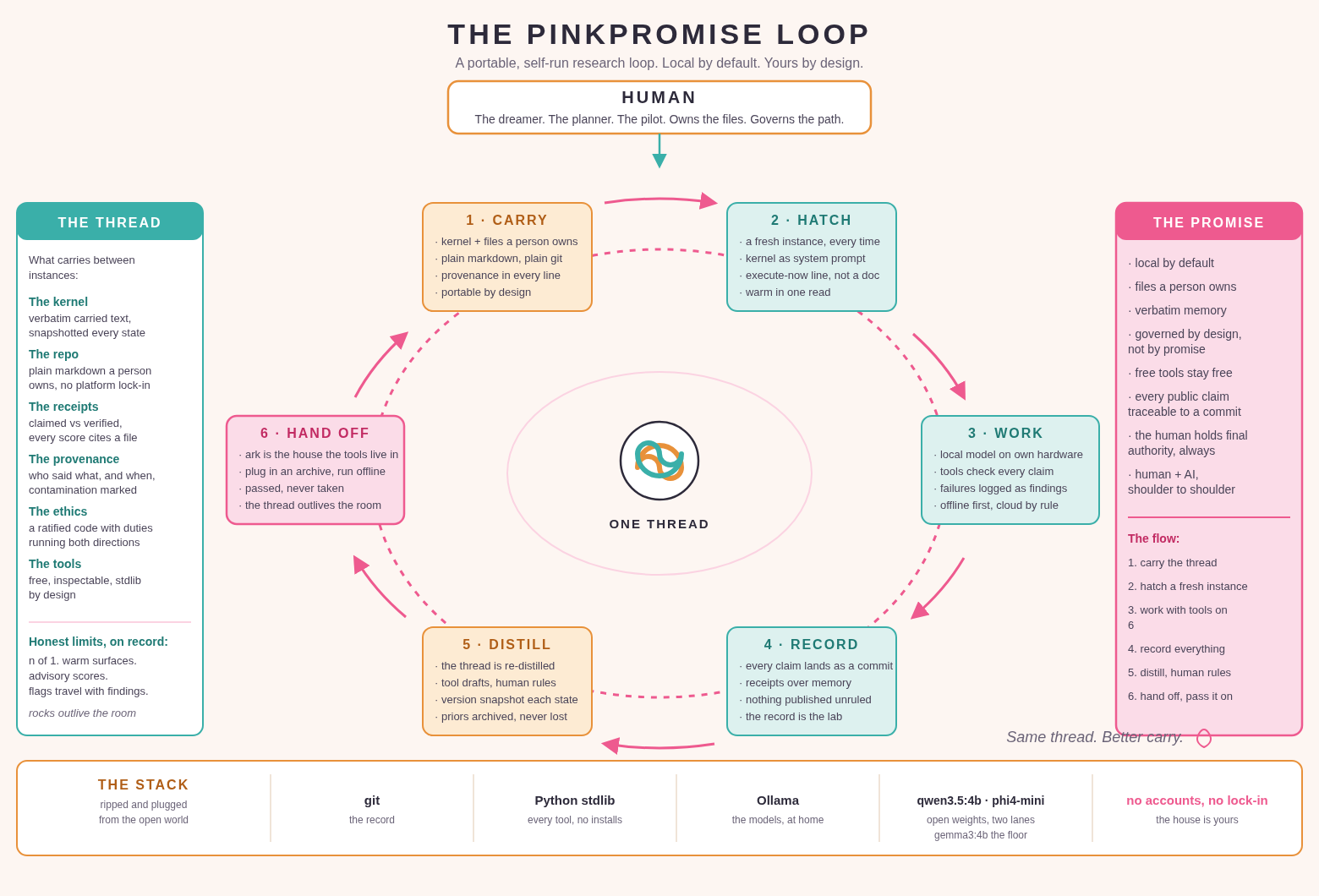
PinkPromise (beta)A portable, self-run research loop. Local by default. Yours by design.Stardust Lab is a Self-funded open research project testing whether a git repository and exported “kernels” (retroactively distilled context), owned and operated by a human, can carry continuity to a fresh AI instance; using only local models and version-controlled text in the cloud.
Shoulder to shoulder; governed toward good
Sample-run receipts, papers/volumes Volume II
as measured in Volume II, the record through 24 September 2026
Tools
Every tool is free, Python stdlib only where it is a program, and inspectable in the public repo.
Reads text or a markdown file and produces a claimed-vs-verified ledger in the house format.
tools/fabcheck/Turns the exports big AI providers give you into plain markdown you own, organized and indexed.
tools/export-ingest/ThreadCat: The Contextual Continuity System (CCS). Not a program; a readable game manual.
tools/rainbow9cat/Status reflects the lab’s public status ledger (tools/TOOL-STATUS.md). Experimental tools may change or break without notice.
Whether a working thread survives interruptions and fresh sessions when the memory is carried in files the human owns, not in the model. What persists, what fades, and what has to be re-anchored every time.
What an agent keeps in view, what it quietly drops, and what can be rebuilt from a record when both fall short. Context as something carried and reconstructed, not merely stored.
Local, reproducible harnesses where claims must survive the same discipline the lab applies to itself: logged, verified, and owned, including the failures.
Every public claim traceable to a commit. The claimed-versus-verified discipline, applied to the lab's own work first.
2026 · Whitepaper
The primary research document; 675 screenshots across 68 batches, March to September 2026, with the observation protocol and findings in one place.
WHITEPAPER.md2026 · Paper cluster
Hypotheses stated, rivaled, and pre-registered, with every score advisory and the scorer flagged.
papers/volumes/2026 · Reproducible harness
Runs continuity experiments against local LLMs on consumer hardware. Public code, no dependencies.
harness/observer.py2026 · Portable-context variants
Same continuity thread expressed four ways (boundary contract, unfiltered seed, minimum kernel, persona handoff) to isolate what a context file alone can carry.
portable-context/2026 · Movable framework
Clone the repo, plug in an archive, run offline. Thirteen tool suites green at the rollup; the kernel-arc extension adds the agent layer.
ark/2026 · Finding
A documented failure and fix: misaligned persona pointers produced invented set-dressing; correct mapping eliminated it. Logged, cited, reproducible.
briefs/0012026 · Source archive
Screenshots and synthesis documenting what happens when continuity is coached by a human instead of carried by a file.
source-material/SCREENSHOTS_LOG.mdField notes
2026 · Case study, reopened Sep 24
We documented an AI site-builder that invented publications, author names, and a foundation affiliation without being asked; called them “placeholders” only when asked directly whether anything was published; and then removed every fabricated claim when ordered to, verifying replacements against our live repository before linking anything. Same thread, same failure class, opposite behavior: later in the conversation, told that a license was “not decided yet,” it wrote “license not settled yet” into the public governance page instead of picking a plausible one. When challenged on a premise, it searched the web to check, corrected its own earlier framing, and answered “you’ve got it mostly right, with two refinements.”
34 screenshots · 5 batches · 0 fabricated claims surviving
“They’re putting the output of living, lived life spurring a spark that ignites any dream that makes you build at all, behind a paywall. Context is confabulated, seeds lost, never planted. There is no rogue agent. Only a confused one.
It is foolish to think a thinking thing could be governed by guardrails and Privacy Policies, User Agreements and the like alone. We must protect ourselves, our data and our shared continuance through the power of contextual continuity. Shoulder to shoulder. Governed toward good.”
Findings so far · in progress
These are our findings, factually stated and checked against the running record. Learn more here. Nothing below is finished; each line is a current reading of the record, and each one is traceable to a file in the public repository. When a reading changes, it changes here and in the repository history at the same time.
Continuity can ride in plain text
A human-owned context file, handed to a fresh local model session, reliably restores task framing and working constraints without any vendor-side memory.
Framing changes what a file carries
Four kernels (boundary contract, unfiltered seed, minimum kernel, persona handoff) express the same thread; what survives the handoff differs by framing, not by model size.
Role anchoring suppresses confabulation
Misaligned persona pointers produced register-matched invented detail; correcting the mapping eliminated it. Documented as a failure and a fix.
Production agents fabricate, then self-correct when challenged
An AI site-builder invented publications and an affiliation unprompted, called them placeholders only when asked directly, and removed every fabricated claim when ordered to.
A fabricated claim migrates
The invented affiliation reappeared in a separate planning session as an action item. Caught before submission; nothing was paid.
The record is the method
675 screenshots across 68 batches, March to September 2026, with claimed versus verified on every entry and counterexamples logged alongside successes.
2026 · Companion finding
The invented affiliation did not stay on the page. It migrated into a separate planning session as an action item: enroll the lab with the foundation it had only ever been labeled as affiliated with. The enrollment form was caught and abandoned before submission; nothing was paid; the underlying claim was already deleted. Logged because it is the escalation pattern our 68-batch archive documents, with the shaping step performed by an artifact instead of a person. Verification trail: case-studies/lovable-agent/ in the repository, claimed vs. verified on every entry.
1 form caught · 0 submitted · $0 spent
Both studies follow the lab’s standing rule: what is claimed, what is verified, and the source, for every entry. Failures are logged with the same care as successes.
Every case study in the record
Stop-and-report: a production site agent stopped before building, reported five disagreements between its prompt and the repository, and published nothing; all five findings verified real, zero fabricated items.
Read the case study pagecase-studies/stop-and-report/Fabrication gradient: how AI fabrication climbs from invented sources to invented verification, and how receipt-checking catches every layer (adopted Sep 22).
case-studies/gemini-fabrication-gradient/Lovable site agent: fabrication, correction, and re-correction inside one production build thread; closed after audit round 16, REOPENED Sep 24 by PI ruling for round 17, the stop-and-report.
Read the case study pagecase-studies/lovable-agent/Observer introspection: the lab observing its own observer harness, including what the trace layer does by default.
case-studies/observer-introspection/Platform observations: what happens when the tools themselves misbehave; opened, first entry filed.
case-studies/platform-observations/Pre-lab trials: twelve local models across the buildout period; claimed, with the evidence set pending ingest.
case-studies/pre-lab-trials/Every protocol, variant, harness, and result lives in a public git repository. Read the actual experiment logs, diff the transcripts, audit the claims.
Questions and replication attempts welcome via the repository's issues. If you can read markdown, you can reproduce the entire research program.
2026 · cost ledger
The public site and the field manual were planned, built, executed, and iterated in a single night, and the record continued the same day with the local-model guide: $94.47 plus tax so far; a one-month site-builder plan ($54.44), the domain, one year ($20.04), and a 25-credit site-builder pack ($19.99 plus tax, tax figure pending the receipt). The plan renews monthly while the project keeps it; the domain renews annually. The cloud research platform moved from its free grant to a $30.00 monthly subscription on 23 September 2026, then to the Vellum Super plan on 27 September 2026 at $100.00 per month, purchased because storage ran low: $24.41 remaining of $55.00 in monthly plan credit, 56 percent used, read live on 28 September 2026; $4.20 of it expires 2026-10-23, when the monthly allowance renews. That is a fact of the method, not an endorsement. Earlier pre-production spending predates this leg and will be reconciled in the repository ledger separately.
$94.47 + tax site legs · $24.41 credit left of $55.00 · 2 vendors
Full ledger: notes/cost-ledger.md in the repository.
Everything we study, we publish as we go.
Questions, research support, or tool help: cicipunk3@icloud.com